

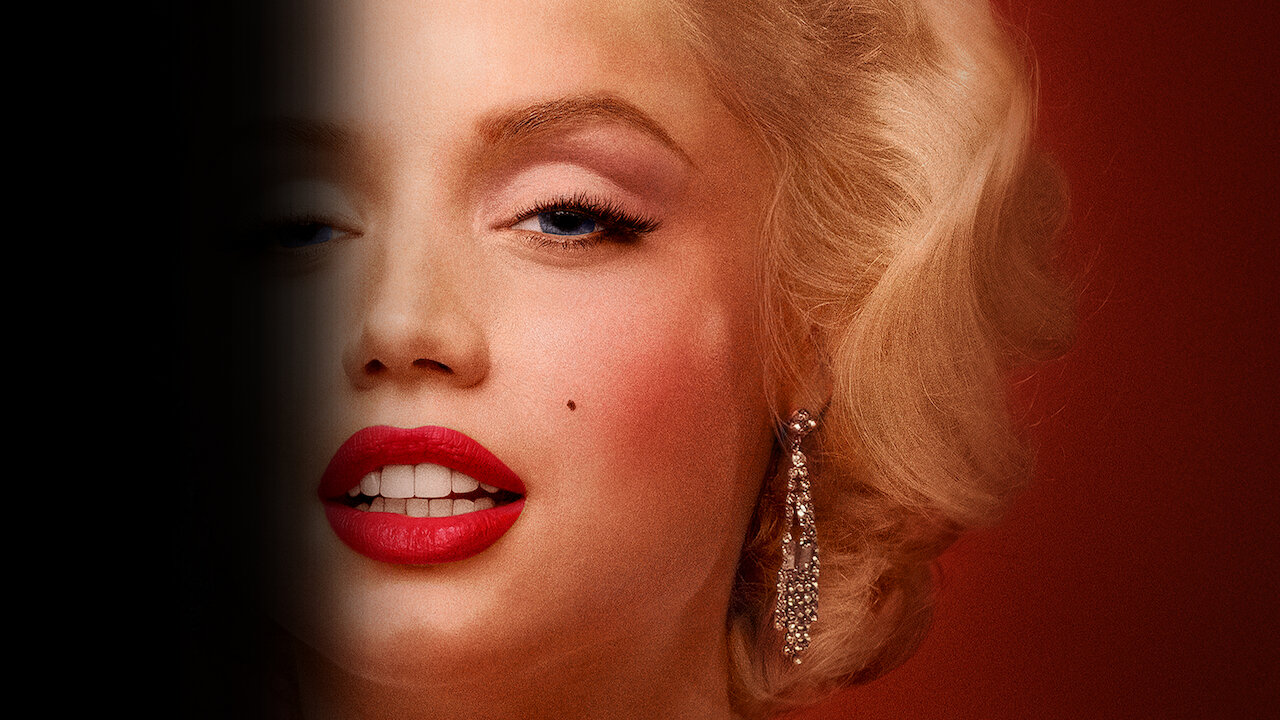
‘Aunt Grace would say things to me like no one else would ever talk to me,’ Marilyn Monroe said of her legal guardian, Grace McKee, who took care of her after her mother’s breakdown. With Aunt Grace she felt ‘as whole as a loaf of bread nobody’s eaten.’
In Netflix’s new biopic drama Blonde, based on the biographical novel by Joyce Carole Oates, men swarm around Marilyn—grasping, clinging, manipulating, touching, hitting, persuading, drugging. At a red carpet event the camera zooms in on crowds of men slavering and gnashing their teeth at her—she looks and feels like a piece of meat thrown to a pack of hounds. Blonde effortlessly blends Marilyn Monroe’s adult trauma with the childhood trauma of Norma Jeane Baker, as she was once known, so that when the camera shows Marilyn, the audience sees the little girl who grew up without a father and with a mentally ill and abusive mother.
Throughout the film Marilyn is visited by apparitions of her father, sometimes as voices in her head, sometimes via letters (did he really send them or are they sick fan-mail?) Her final image as she dies in bed is that of her father, suspended in smoke and dressed like a film noir actor, mysterious, omniscient, god-like. It is a call-back to the film’s first scene, in which Norma Jeane’s mother, Gladys Pearl Baker, confides in her daughter about her relationship with the father. ‘There are complications in both our lives,’ explains Gladys, to a riveted six-year-old Norma Jeane.
Later, Gladys will tell Norma Jeane that she blames her for her father’s abandonment—she was why he left. There follows a psychotic breakdown in which Gladys attempts to drive herself and her daughter into a raging fire and when she is thwarted, she takes Norma Jeane home and attempts to drown her in a scalding bath. Gladys was a paranoid schizophrenic and hospitalised for most of her daughter’s life. Norma Jeane grew up in ten different foster homes between 1935 and 1942 and was sexually abused by a number of her carers, including Aunt Grace’s husband.
Blonde is a film about the after-effects of childhood abuse and abandonment. As Mark Kermode points out in his Guardian review, ‘[Blonde] isn’t really about Marilyn at all. It just happens to be wearing her wardrobe.’ He’s right—it could be about any little girl who experienced the cruelties Norma Jeane faced at a young age. Fame exacerbated her stress and anxiety, but plenty of damage had already been done long before her first picture.
The film’s two hours and forty-six minutes show us little of Marilyn on screen or even in the studio. Director Andrew Dominik deliberately chooses to focus on her struggle with mental illness and the series of relationships and misfortunes that exacerbated it. It is a hard watch—Bobby Cannavale plays a needy and abusive Joe DiMaggio, alternately crying and clinging to Norma Jeane and then beating her. There is a scene with his Italian family in which a matron hands Norma Jeane a hard-boiled egg—should she eat it? It isn’t clear.
The audience shares her bafflement and sense that others are often laughing at her for unknown reasons. Ana de Armas is mesmerising as Marilyn and Norma Jeane. She captures Marilyn’s overplayed facial expressions and ingenue naivety, which on screen are enchanting even if not very good acting. There are moments, the solo during the filming of Some Like It Hot, for example, which I actually thought were real recordings of Marilyn, so alike was Ana de Armas.
The rest of the film manages to weave those iconic moments beautifully into the context of Norma Jeane’s declining mental health. The narrative skips ahead and it is unclear how much time has passed—fragments of memory become indistinguishable from nightmares as she consumes more sleeping pills and champagne and the pressures grow from studios and doctors and lovers. It is beautifully done.
Critics of the film complain that it further exploits the pain of an already-abused, world-famous woman. ‘Retelling this narrative of abuse does nothing to push the conversation about women’s treatment forward,’ says a Refinery 29 review of Blonde. ‘Instead, using…real trauma to manufacture a box office hit is just another way that [she is] being exploited.’
This attitude dismisses the power of storytelling to address the exploitation Hollywood once put women through. Marilyn Monroe’s story has been told before but did any of us know the extent to which she was mistreated and exploited? Her mother’s mental illness was kept from the press and public out of pressure from the studios, and so was her own. But is that really the best way to address mental illness?
Blonde faces mental illness and suicide of a well-known public figure head-on and the result is a heart-wrenching, tragic story. Is it exploitative to tell a sad story? Critics argue that by portraying Norma Jeane as a victim the film takes away her agency. The thing is, a person who is wrestling with severe mental illness is fighting a battle for agency over their own life, and those who die by their own hand have fought the battle and decided they were tired of fighting.
And Norma Jeane was a victim— of parents and carers, husbands, lovers and of 1950s Hollywood. In Blonde, a young Norma Jeane leaves an audition with a big studio where she was raped by the executive in his office, and as she leaves one of the producers says to another, ‘Sweet Jesus, look at the ass on that little girl.’ Men in Hollywood don’t come off well in the film and if their treatment is a little heavy-handed, this is after all a story from a young girl’s perspective.
There were men who cared for her—Arthur Miller played by Adrian Brody is a brooding but devoted husband, but such is Norma Jeane’s fragility that a bad turn of events—a miscarriage in this case— sends their once-stable relationship spiralling to destruction. ‘Darling, where do you go when you disappear?’ Arthur asks Norma Jeane in one of the film’s most poignant moments. You can see in her expression that she isn’t really there— she is physically in the present but emotionally in the past, reliving the trauma of her childhood over and over again while grieving the loss of her own child.
Today it is thought that Norma Jeane suffered from bipolar and borderline personality disorder, alongside post-traumatic stress and anxiety. For women with those conditions, the childbearing years can bring back their own childhood trauma. Blonde portrays Norma Jeane’s desire to be a mother in heart-rending moments—should she keep the baby growing inside her and ruin hopes of career success by dropping out of filming Gentlemen Prefer Blondes? She caves to studio pressure and is haunted by the thought of the baby she let go. Flashbacks to a forced abortion recur—but are they a nightmare, or did it really happen thus, with a room full of men watching a doctor force an instrument inside her and remove the baby?
The truth almost doesn’t matter— Norma Jeane tortures herself with the image nonetheless. The film is excellent on the power of mental distress as it clouds memory and makes life seem like one terrible, never-ending nightmare. Her unborn foetus appears on screen at random moments, popping into our minds like with unsettling, critical words for its mother. The fragmented narrative and whispered dialogue between Norma Jeane and her foetus escalate as the drugs and alcohol take hold.
The film’s final image is of her leg hanging lifeless off the side of the bed where she died. Not since Joaquin Phoenix’s Joker has a major feature film portrayed such heavy topics so beautifully and compassionately—Blonde is a hefty nearly-three hours but it’s worth it.
Feature image credit: Netflix
Check out more Entertainment Now movie news, reviews and interviews here.