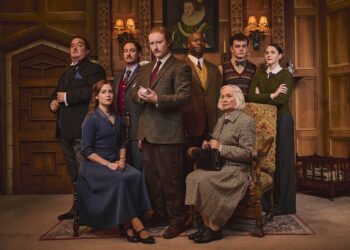


Sherlock Holmes: The Hunt for Moriarty opens on Baker Street, a great-looking set that fits what you would imagine a Sherlock play should be. From there it makes a smart structural choice, starting at the end of the story before rewinding to show how we got there neatly anchored by Watson’s narration.
Ben Owora’s Watson works well both as narrator and as part of the action. His narration isn’t just scene-setting at the start, it runs throughout, adding colour, describing details like rolling fog, and occasionally filling in the gaps, all while keeping the story easy to follow without ever feeling like he’s just there to explain things to the audience.
Mark Knightley’s Sherlock is great fun to watch. This isn’t slapstick or mugging for laughs, but a chaotic, constantly-firing brain that spills out physically, whether through thrown letters or frantic disguise changes, in a way that feels natural to the character. The script also doesn’t shy away from Sherlock’s darker edges, with nods to his drug use (commentary only, nothing explicit) and a deliberately awful violin performance, complete with the suggestion that cocaine might be preferable. It all adds texture without tipping into parody.
Gavin Molloy impresses hugely across multiple roles, Inspector Lestrade, Professor Moriarty, and even a nerdy archive clerk among others. His physical transformation between characters is genuinely striking; when he’s Moriarty, it honestly feels like his entire face changes, while his archive clerk is quietly comic and perfectly judged.
With a small cast doubling and tripling roles, the production never feels stretched. Pippa Caddick takes on all the female roles and does a great job differentiating them through accents, posture and presence. The slickness of the ensemble work means that, even if you momentarily clock an actor re-entering as someone new, the illusion quickly re-establishes itself.
The set is used cleverly throughout. Letters are projected onto the back wall as they’re read, drifting away as scenes move on, while illustrations reminiscent of the original Conan Doyle stories appear at key moments, a door opening to reveal a body, for example. Locations shift quickly with simple movements of walls and furniture, avoiding long scene changes and keeping the pace up. Fight scenes are well choreographed and clean, adding tension without ever feeling messy.
Despite being a fairly long play, it never really feels like it. The balance of humour, mystery and tension is well judged, the energy stays consistent, and the audience is with it throughout, laughing and leaning in at all the right moments. One accidental bit of physical comedy, when Sherlock threw his jacket into the air only for it to spin perfectly back onto his shoulder, got a genuine laugh from both cast and crowd before everyone carried on without missing a beat.
If you know your Sherlock, you’ll probably spot where parts of the story are heading, but that doesn’t hurt it. It respects the source material, plays confidently within it, and delivers a sharp, entertaining night at the theatre that’s easy to recommend to fans and non-fans alike.

Sherlock Holmes: The Hunt for Moriarty is at Everyman Theatre Cheltenham until 24th January. Tickets available here