
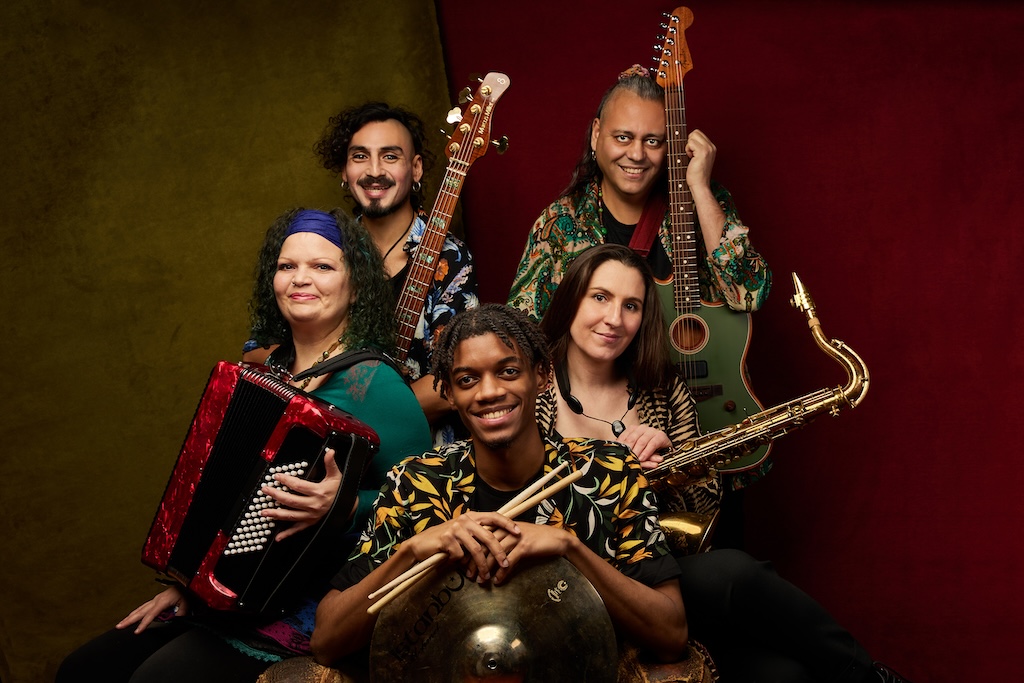
The band AJISMA, based in France but with roots in South America create Latin American infused avant garde music which invites listeners to tune into their inner life-force. Performing in Spanish, French and English they tell Entertainment Now about their new EP Rayün.
AJIMSA began in 2016 between Chile and France. How did the project come to life and what brought you together musically and personally?
Ajimsa was born from the honest and spontaneous compositions of its founders, Cristian (Chilean) and Julie (French). Honest, because they were nothing more than the reflection of the life they had experienced up to that moment, a reflection of both their inner world and the world around them. It was at this historic moment for the band that Cristian and Julie, despite their cultural differences, came together and the magic happened, where language and cultural barriers disappeared. Two people who had only in common being born and raised at the foot of two imposing mountain ranges, the Alps and the Andes respectively, founded Ajimsa.
The band was born in Santiago de Chile with their first album “Cosmovisión”, and became a quintet.
The name Ajimsa is unique and intriguing. What does it mean and why did you choose it to represent the band?
Ajimsa is derived from Ahimsa, a Sanskrit concept from India meaning “respect for life in all its forms”. The modification of the H to J was our choice to write it in a different way and make it sound a little different from the original word in Chile and abroad.
At the time of the band’s founding, we were deeply reflecting on the current economic model: realizing that the model has prioritized the accumulation of wealth over human life, as well as that of the eco-systems, and has turned the meat and meat-derived industry into a living hell for sentient and defenceless beings, we embraced respect for life and empathy as a path of struggle and inspiration.
Tell us more about your new single “Quatre Accords”
The four Toltec Agreements that inspired this song remind us of the simplicity of life and highlight how we ourselves complicate it, whether through expectations, fears, or a lack of attention to our personal relationships. Life is already hard given the social injustices and precariousness of jobs, and on top of that, we fail to care for each other with love and empathy.
Can you tell us a bit about the visual world of the “Quatre Accords” video? What messages or feelings were you hoping to evoke through the imagery?
The video has several approaches that in some way complement the song’s message. First, it suggests that we have built functional personalities according to what the economic model demands of us, even when this goes against our mental health, happiness and human relationships. The word “personality” which in late Latin is “Personalita” means “Mask”. It is the inspiration for why the main character is a mime wearing a painted mask that evolves throughout the video. The protagonist begins the day feeling a certain disappointment in herself, not finding herself in the mirror.
However, upon stepping out into the world, she continues with her individualistic personality, but it is the empathy and support of those around her that awaken a light of change, reflection and self-criticism that will bring healthy transformation to her life.
AJIMSA perform in French, Spanish, and English. How do you choose which language best fits a song and how do multilingual lyrics influence your connection with global audiences.
Sometimes, the language chosen by Julie (lyricist and singer of the band) comes without thinking much. In other cases, Julie tries to write in a certain language and then shifts to another because it sounds better or seems to fit better the music and the subject of the song. Since the beginning, Ajimsa has wanted to bring their message and connect with audiences from all over the world, either on stage or through digital music platforms. This is the other reason why the band hasn’t focused on only one language.
Your music often draws from indigenous wisdom and traditional cultures. How do you approach this with respect and authenticity, especially in today’s complex cultural landscape?
The band was born in Chile, where serious conflicts exist, stemming from state-run and private companies against indigenous peoples. Deaths and human rights violations, all in the name of stealing their sacred lands, destroying everything with the sole objective of transforming paradise into money. Traveling through the Americas, from Mexico to Patagonia, we realized that, in one way or the other, the same thing happened in every country. We also realized the reasons that drive these brave defenders of the planet, who, despite losing their lives, their children’s lives and their communities, have continued a relentless struggle for centuries.
We then discovered their great wisdom and understood that behind their struggle, traditions, myths, and history, lie many of the keys to re-directing this world that is heading for self-destruction.
Finally, your EP Rayün is coming this fall. Without giving too much away, what can we expect in terms of sound, message, and evolution from your previous releases?
“Rayün”, which in Mapudungun, the language of the Mapuche, the indigenous people of southern Chile and Argentina, means “to flourish”, is a call for change, to build a better world, starting with ourselves and working collaboratively as a community. We must never lose sight that our co-workers, neighbours, whether they are migrants or practice a different religion, are not our enemies.
For us, music is the freedom to imagine people united and in harmony. That’s why for example, on this EP you can hear inspirations from Mexican music, a predominantly Christian country, together with influences from Gnawa, a music originated in specifically Muslim Africa.
Listen here: