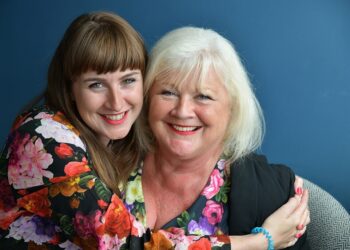

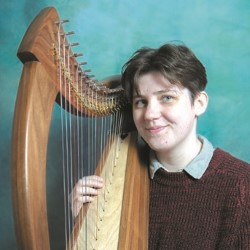
Combining harp music, theories about thirteenth century religion and stand up Catriona Dowden has a lot going on. Her new show Sesh Head talks about growing up with a musically inclined Irish family and includes an experimental performance of a piece of medieval music. She’s got a lively Fringe planned and plans to reinvent herself by bringing out her wild side.
Tell us about your show. Why should we go and see it?
“Sesh Head” is a standup comedy show (with harp) about folk music and family history. It’s inspired by my own background in traditional music, and the experience of growing up in England with Irish heritage. You should come and see it to justify the many hours I spent as a teenager learning Wonderwall on the harp instead of socializing. But you should also come for ghost stories, Biblical Kings, and jigs.
What is your favourite thing about your show?
My favourite part is probably the ending. Without revealing too much, I conclude the show with an experimental performance of a thirteenth-century piece called “Sumer is icumen in” because you have to end on a high.
Do you have a Fringe idol?
Rob Auton is someone I always try and see early on in the Fringe – to me his work embodies what the festival is about.
What three words best describe your performance style – and why?
I’ve been reviewed as “idiosyncratic”, “deadpan” and “pallid”. This year, though, I’m reinventing myself as high-energy, intimidating, and electrifying, through the power of harp music.
Who are you looking forward to seeing in Edinburgh?
Nate Kitch is always fantastic and completely original. I’m looking forward to Tasmin Sarkany’s debut, and new shows from Adam Larter, Michael Brunstrom, and Cheslea Birkby. Mark Dean Quinn and Consignia are must-sees at Fringe.
What do you hope to achieve in Edinburgh – what are your hopes and dreams?
I always try to go into the Fringe with achievable goals. Firstly, to try something completely new onstage (this year I’m combining music and standup in my act for the first time), and secondly to keep building an audience of people who will want to come back and see the next show. And to take the music industry by storm with my reinvention of thirteenth-century polyphony, but that goes without saying.
What are the biggest obstacles you face as a performer at the Fringe?
This year, the main obstacle will probably be carrying a (small) harp from one side of the city to the other every day. Last year I performed as a medieval anchoress and had to carry a cardboard church around with me, but the harp is slightly heavier.
What do you hope the audience will take away after an hour in your company?
I hope that they will be full of adrenaline from the high-octane harp performance. And also a deeper understanding of trad music, its complex history, and the nuances of British-Irish identity. But mainly the first one.
How do you plan to relax and recharge when not on stage?
Probably work on my PhD about twelfth- and thirteenth-century visions of the afterlife, which I am supposed to be finishing reasonably soon. Reading about the fires of purgatory will be a welcome respite from the chaos of the festival. I also plan to go to lots of folk sessions with the aforementioned harp and maybe learn some more Scottish tunes.
What is your idea of a perfect Fringe day?
I head to a café in the city centre and take out my notebook. I pretend that I am going to rewrite the entire show before 5pm, knowing deep down that I will revert to the original script ten minutes beforehand. I do a set at Standup Philosophy, one of my favourite compilation shows at the Fringe, hosted by Alex Farrow, in which he asks comedians to explore a philosophical question through jokes. Later in the afternoon, I begin flyering for my show, but (it being my perfect day), everyone who passes by is immediately charmed and takes a flyer, vowing to return and watch the show without me having to say a word. Everyone who said that they would come to the show was telling the truth, and I am inundated with audience members. It goes so well that at the end, I crowd surf whilst playing the thirteenth-century piece “Sumer is icumen in”. As the performance comes to a close, I continue to crowd surf all the way down South Bridge to Mosque Kitchen, where I meet some comedian friends for dinner. I spend the rest of the night watching shows, perhaps ending up at ACMS.
Catriona Dowden: Sesh Head, 17.00, Room 2 @Carbon, PBH Free Fringe
https://www.edfringe.com/tickets/whats-on/caitriona-dowden-sesh-head