
Edinburgh native and Entertainment Now writer Molly Reay visits the Edinburgh Military Tattoo and loves it
At 19, I’ve grown up with the Royal Edinburgh Military Tattoo as one of those Edinburgh traditions that feels almost like part of the city itself. I’ve seen the stands go up, watched the crowds gather along the Royal Mile and heard the pipes drifting through the city, but there is something very different about actually sitting inside the Castle Esplanade and watching the Tattoo unfold in front of you.
This year’s Royal Edinburgh Military Tattoo felt like a show that had asked everyone involved to go above and beyond. From the creative team and volunteers to the technicians and, most of all, the performers, “A Call to Gather” seemed to demand something extra from everyone who stepped onto the Esplanade.
Now in its 76th year, the Tattoo has been filling the Esplanade with music, marching and spectacle since 1950. It was born out of a post-war desire to boost public morale and strengthen the values of allyship, and although the world has changed considerably since then, those ideas still feel remarkably relevant today. As a 19-year-old, I think there is something particularly interesting about seeing such a long-standing tradition through a modern lens. The Tattoo is steeped in history, but it doesn’t feel like it belongs solely to the past.
I was lucky enough to get tickets to the preview show this year, and went along with my friend, Summer. We had to swim our way through the Fringe crowds that had completely taken over the Mile before beginning the familiar climb up Castle Hill towards the castle. There is something quite surreal about being surrounded by thousands of people dressed up for Fringe shows, tourists taking photographs and street performers shouting from every corner, before suddenly finding yourself heading towards one of Edinburgh’s oldest and most recognisable traditions.
After eventually finding the right entrance — an endeavour I have somehow managed to make more complicated than it should be on previous visits — we found ourselves underneath the enormous metal stands.
The bar queue was already mobbed, and with time not quite on our side, we decided to give the drinks a miss and head straight for our seats in the South Stand. We settled in, chatting away and taking in the atmosphere around us. Then the overture began. Almost immediately, the chatter around the stands softened, and that unmistakable feeling of anticipation spread through the crowd like a wave.
The ancient Celtic Carnyx opens this year’s show. It is, essentially, an instrument of war — and, admittedly, one that looks rather like a pig on a pole. Its harsh, abrasive brass sound would once have echoed across ancient battlefields, and now it echoes across the Castle Esplanade. I couldn’t think of a more fitting way to begin the Tattoo.
Then came the Drum Majors, standing in their martial majesty and forming a compass across the Esplanade. The Pipe Majors of each band played the old piobaireachd “MacDougal’s Gathering”, followed by the slow air “The Skye Boat Song”. Both tunes carry a real sense of pride and heritage, and their significance to this year’s show becomes increasingly clear as they return throughout the evening.
Then the drawbridge opened.
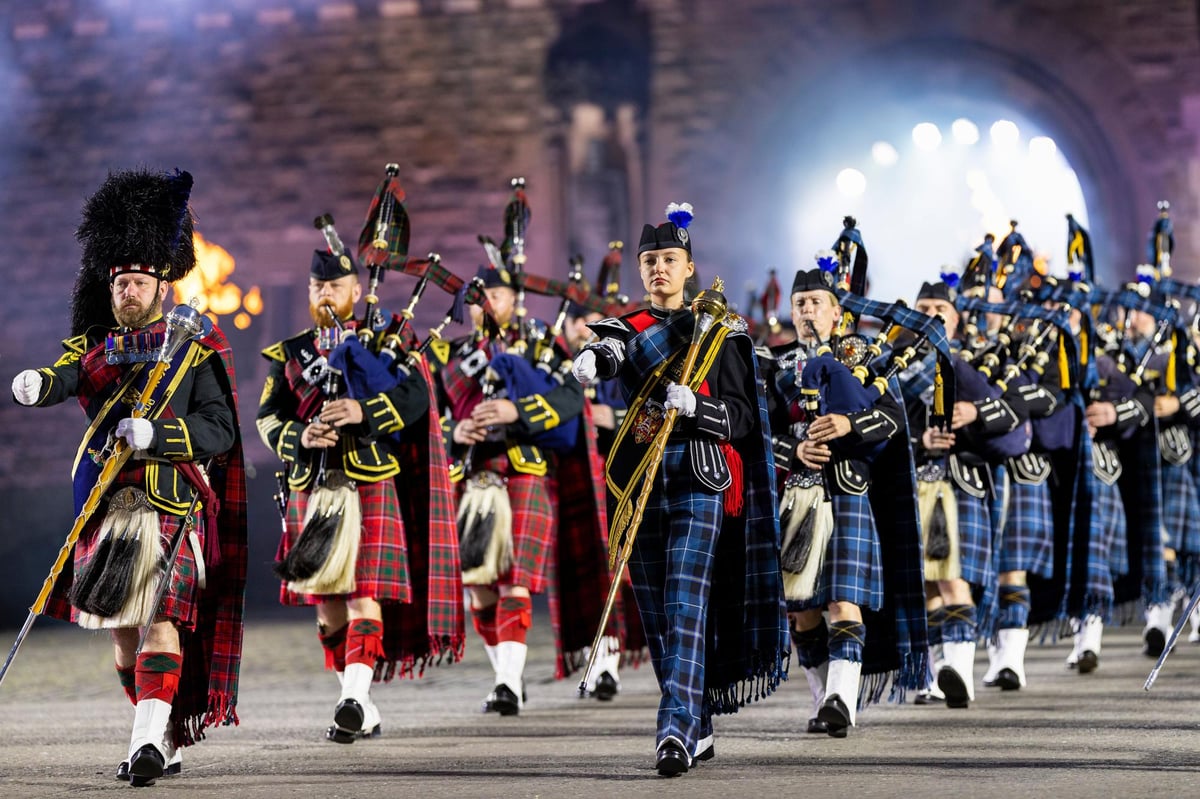
Out of the smoke came the massed pipes and drums.
The Senior Drum Major gave his word of command, and suddenly the band began its march down the Esplanade. The sound seemed to silence the entire crowd around me. Most people who have spent any time in Edinburgh will have heard a lone piper playing somewhere along the Royal Mile or Princes Street but hearing more than a hundred pipers playing together is something else entirely.
I genuinely got goosebumps.
I’m used to seeing music and performance through a very modern lens — concerts, festivals, TikTok trends, big pop productions — but there was something completely different about watching hundreds of performers create this enormous wall of sound without needing any of the usual spectacle associated with modern entertainment.
From our seats, some of the highest on the Esplanade, I had a surprisingly good view of the formations below. The pipe bands moved with such precision that, from above, they almost stopped looking like individual people. Instead, they looked like a tapestry being woven in front of me, with each performer becoming an intricate stitch in the fabric.
And it turned out that the formations themselves were works of art.
One of the most striking was the Celtic triquetra, more commonly known as the Trinity Knot. Its three interlocking corners represent unity and gathering, making it particularly fitting for this year’s theme. After spilling out from the drawbridge, the massed pipes and drums threaded between one another with almost mesmerising precision, eventually forming the symbol.
What struck me most was how effortless they made something so complicated look. Whether they were marching to a strong, driving beat or moving through the more thoughtful and lamenting notes of a slow air, every performer seemed to know exactly where they needed to be. There was no hesitation, no second-guessing — just hundreds of people moving as one.
As is tradition at the Royal Edinburgh Military Tattoo, the international performers each brought their own cultures and traditions to the Esplanade. This year, Germany, Qatar, New Zealand and America answered the call.
The first half-hour of the show is themed around a formal welcome, with each international act entering through the drawbridge to a piece of music chosen specifically for them. New Zealand was welcomed with the hauntingly beautiful Māori love song “Pokarekare Ana”; Qatar with the modern composition “The Dawn”; Germany with the world-renowned “Ode to Joy”; and America with “Over There”, harking back to 1917.
Of all the international acts, New Zealand was easily my favourite. Returning to Edinburgh for the eighth time, their performance combined incredibly creative choreography with an impressive marching display. At various points, I felt like I was watching a jazz band at Coachella and a military drill at the same time — an unusual combination, but one that somehow worked brilliantly.
The American set was another highlight for me. Country music, popular songs, dancing, gorgeous blue checked dresses and cowboy hats all came together to create something completely different from the traditional image of a military tattoo. And then, just when I thought the performance had finished, a drum kit appeared from underneath the grandstands and rolled onto the stage for a drum solo.
It was wonderfully unexpected.
For a moment, I felt like I had somehow wandered into a Katy Perry music video — which, admittedly, was not a bad thing at all. As someone who has grown up with pop concerts and music festivals as my idea of a big night out, I loved seeing the Tattoo embrace that same sense of fun and entertainment while still holding onto its military and cultural traditions.
That variety is what makes the Tattoo so enjoyable to me. Yes, it is about marching bands and military precision, but it is also about music, dance, costumes, theatre, culture and spectacle. It is an extravagant celebration of talent in all its different forms, and I think that is why it continues to appeal to people of completely different ages.
Watching it all unfold from above; I found myself thinking about just how much work must go into making the whole thing look so effortless. Every step, every note, every formation and every entrance must happen at exactly the right moment. From where I was sitting, it looked seamless. I could only imagine the hours of rehearsal and dedication behind it.
And perhaps that is what stayed with me most as the evening came to an end.
Seventy-six years after the first Tattoo, its original purpose of bringing people together still feels remarkably relevant. As the final notes echoed around Edinburgh Castle and the performers disappeared beneath the drawbridge once more, I was left thinking that this is what the Tattoo has always done best.
It gathers people.
I’m probably not the person you would immediately expect to be writing about military marching bands and centuries-old Scottish musical traditions. But sitting in those stands, surrounded by people of every generation, I realised that perhaps that is exactly the point. The Tattoo doesn’t belong to one age group. It belongs to Edinburgh.
It brings together performers from different countries, traditions and cultures, and places them on the same stage. It brings thousands of strangers together in the stands, all watching the same spectacle unfold. And, for a few hours, it reminds us that despite all the things that make us different, there is something incredibly powerful about gathering with friends and allies.
Walking back down Castle Hill that night, with the Fringe still buzzing around me, I felt incredibly lucky to have experienced it. The Tattoo is about tradition, certainly, but it never feels trapped by it. Instead, it takes those traditions and finds new ways to make them feel exciting, relevant and alive.
And perhaps that is why, as a 19-year-old Edinburgh girl, I found myself enjoying it so much. It managed to feel both incredibly old and surprisingly fresh — a piece of Edinburgh’s history that is still finding new ways to speak to people of all ages.
This year, “A Call to Gather” did exactly what its name promised. It gathered us together, and for one evening at least, reminded me why this city’s traditions are worth holding onto.